
Competences and learning objectives
A competence and a learning objective both point at knowledge components, which is what makes them easy to confuse. They are different structures, they come from different places, and mixing them up will make a case’s claims read as facts about you.
This page separates them. It assumes you know what a knowledge component is — if not, read Knowledge components first.
The one test
Section titled “The one test”Ask where the thing would still exist if every case in Fito were deleted.
- A competence would still exist. It stands in Fito’s competence registry, whether or not anybody ever wrote a case about it.
- A learning objective would not. It is one line inside one case, saying what that case sets out to develop.
Everything below follows from that.
A competence
Section titled “A competence”A competence is a named, standing capability. It carries a name, an optional description, and three kinds of relation.
A technology demands it. The edge runs both ways in quantity: one technology demands many competences, and one competence may be demanded by many technologies. So a competence like “isolating a domain from its transport” is not owned by whichever technology happened to introduce it.
Elements form it. Each element is defined by exactly one knowledge component — no more, no less. The elements of one competence must all define different components, so nothing is counted twice.
Sub-competences nest under it. A competence can hold other competences, as a tree. A sub-competence has at most one parent.
The three component types split the elements into the two halves Fito models:
| Element defined by | Counts as |
|---|---|
| A concept or an execution fact | Knowledge |
| A usage scenario | Skill |
Your proficiency under a competence is computed, never stored
Section titled “Your proficiency under a competence is computed, never stored”Fito records proficiency per knowledge component. It never records one against a competence.
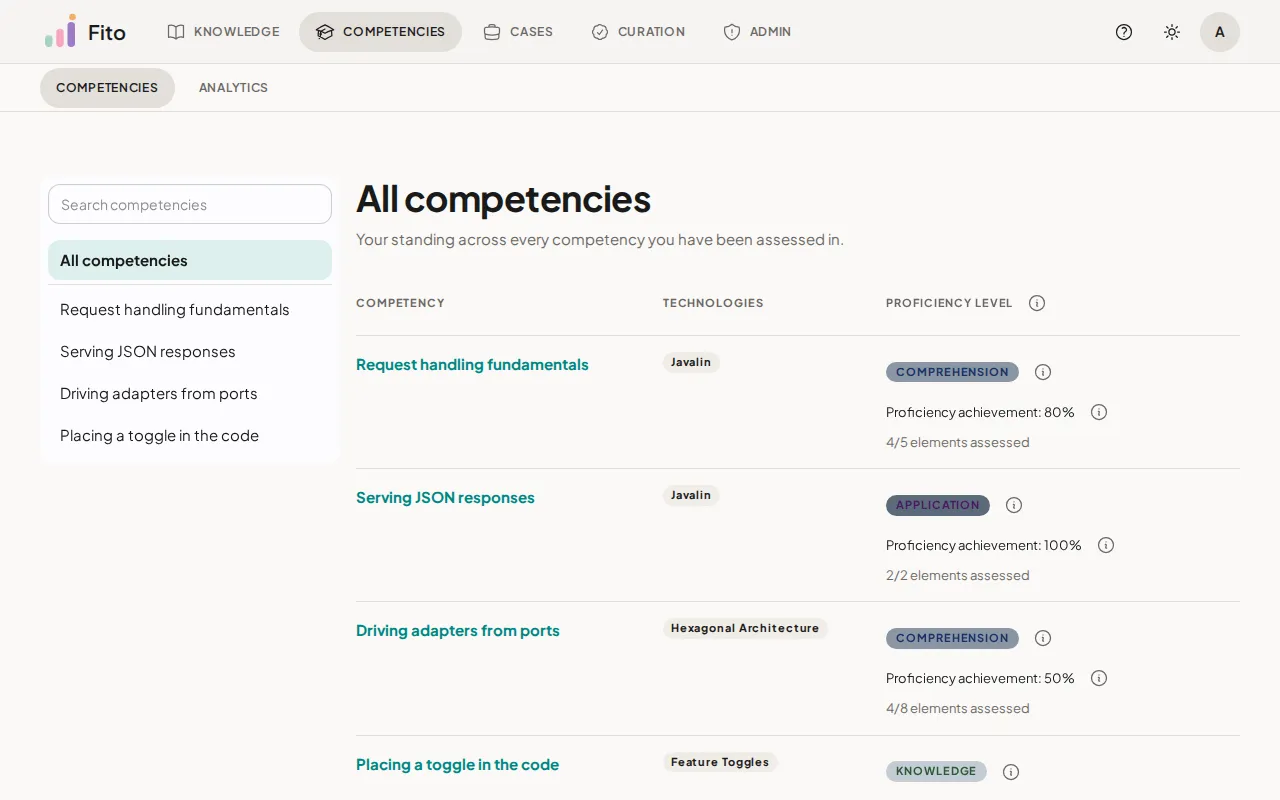
A competence’s level is worked out when you look at it: the mean of every element
it holds, its sub-competences’ elements included, on a 0 to 3 scale where each
recorded proficiency counts as its position — NOT_ACHIEVED 0 up to
APPLICATION 3. That scale is for averaging, not a rubric score. Deduplicated
by component, so a component reached through two branches counts once.
An element you have never been assessed on counts as 0 in that mean, the
same as a recorded NOT_ACHIEVED. So the number measures the whole competence,
not the part of it you have touched. Beside it the view shows how many elements
you have been assessed on out of the total, which is what tells a low score apart
from a thin one.
That is why moving one component forward lifts several competences at the same time. The number was never written down anywhere to be inconsistent.
For what a recorded proficiency is, and how a rubric score becomes one, see Knowledge components.
A learning objective
Section titled “A learning objective”A learning objective is one edge a single case declares about itself: a reference to a knowledge component, tagged with the Bloom level that case targets for it.
It carries two things a competence element does not:
- A description, the author’s note on what the reference means in this case.
- A weight, either
PRIMARYfor an objective the case centrally develops orSECONDARYfor one it touches in passing.
A case’s prerequisites are the same kind of edge, tagged as a prerequisite instead. So one case names two sets of components: what it expects you to arrive with, and what it sets out to develop.
Why blurring them costs you
Section titled “Why blurring them costs you”Read the two sentences side by side:
- A competence says this is a coherent capability, and these components make it up.
- A learning objective says working this case develops this component to this level.
The first is a claim about the subject. The second is a claim about a case. If a page or a prompt lets them merge, a case author’s intent starts reading as the structure of the field, and the registry stops meaning anything.
The Used in cases panel on a component’s page reads the second kind only. It lists published cases that reference the component as a learning objective or as a prerequisite. It never lists competences.
Where to read them
Section titled “Where to read them”The competence registry is public. So is every technology’s demand list, at
GET /technologies/<technology-slug>/competences, and one competence at
GET /competences/<id>.
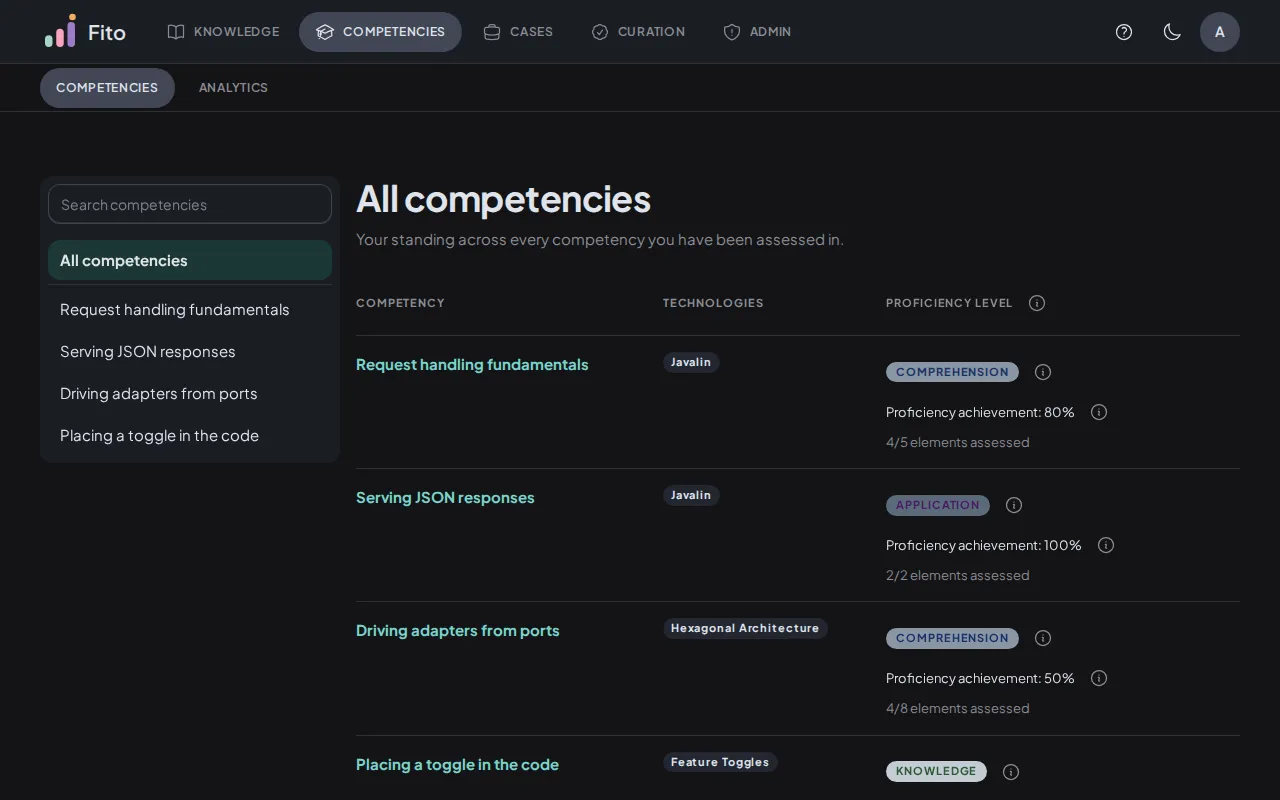
Your own recorded proficiency is not public, and /competencies asks you to
sign in before it shows the table and the per-competence breakdown.
What’s next
Section titled “What’s next”- Knowledge components — what the elements and the objectives both point at.
- Browse the knowledge area — open a component and read its Used in cases panel.
- Author a competence — record one from the terminal, then edit or delete it.